Tombstone of Sempronio Paterno
Roman Stele
Consular Era 361 (AD 323)
Limestone
Location:
Sacristy
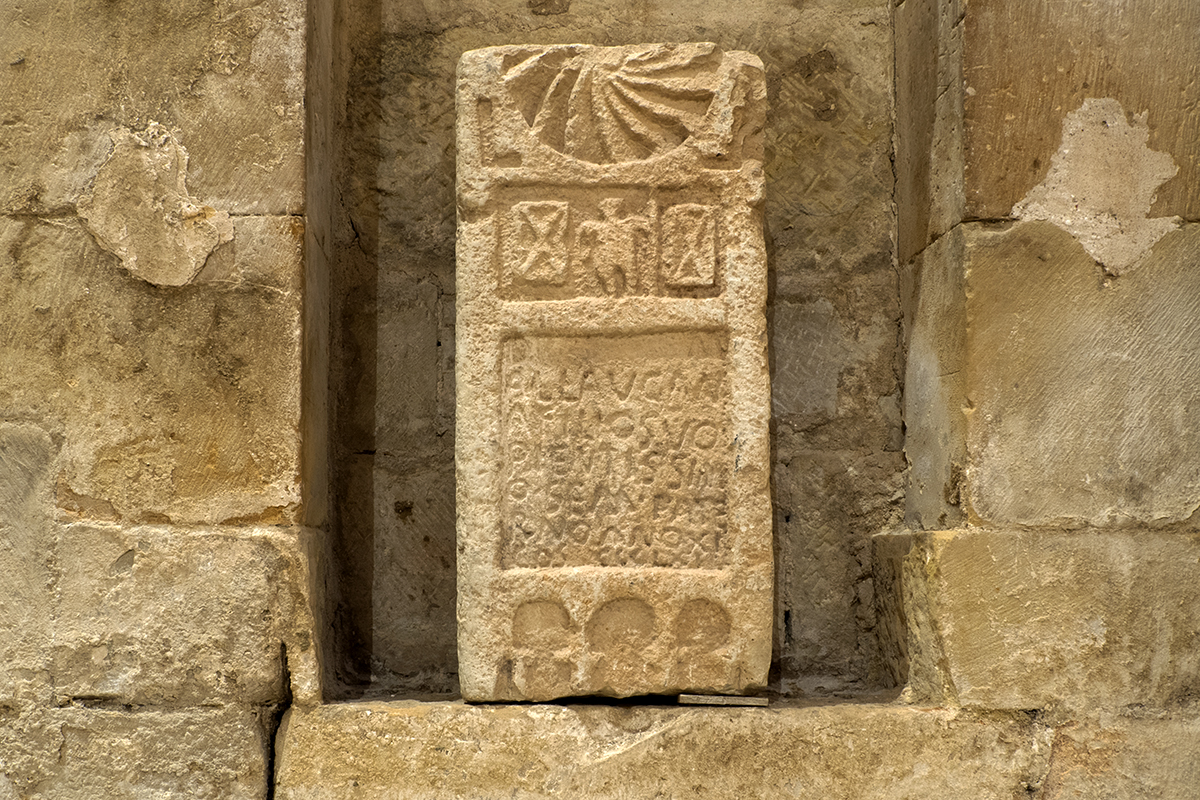
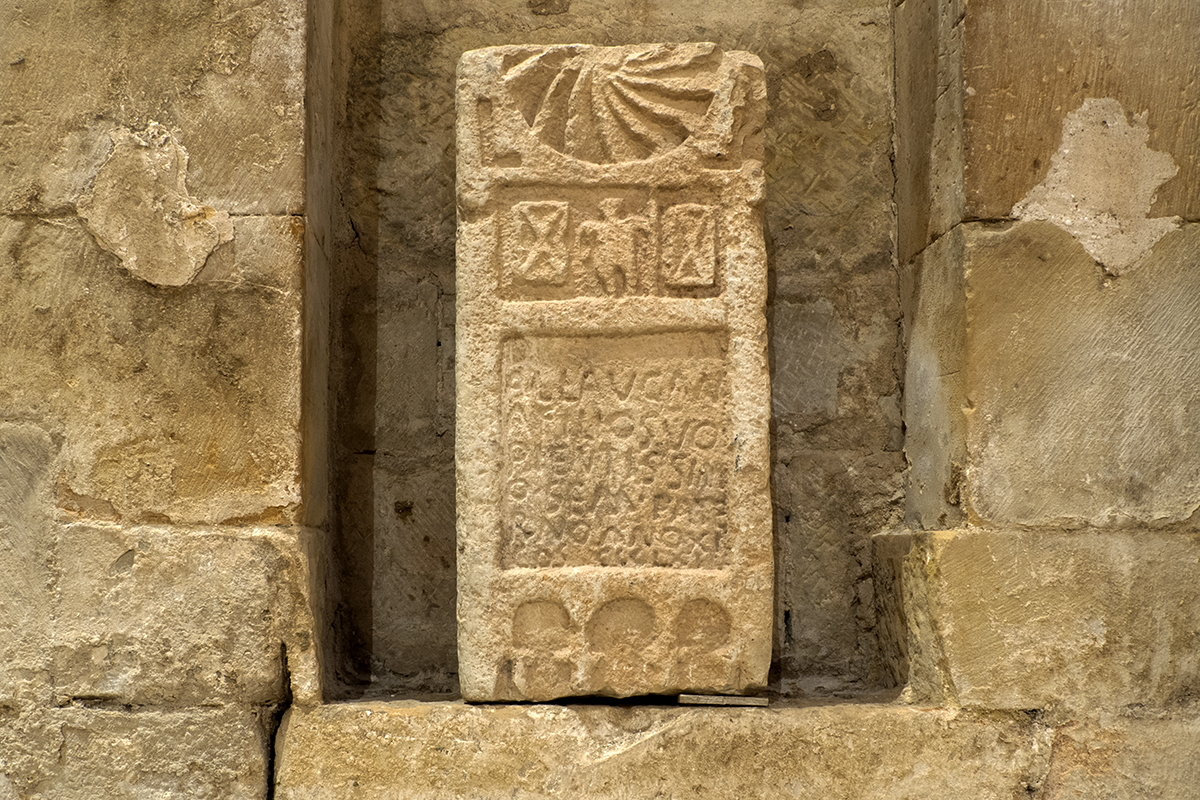
This funerary stele, carved in white limestone, was discovered reused as a building element in a house in the town of Valoria de Aguilar, in the province of Palencia. Such reuse, very common in the area, suggests that its original provenance may have been the nearby site of Cildá, where other stelae of similar typology have been documented.
The piece is rectangular in shape, although it has lost its upper semicircular finial and part of its base. Even so, its decorative program is preserved with considerable clarity.
At the top appears a wheel with curved spokes, carefully carved with beveled edges. This is a frequent motif in the northern Iberian Peninsula and has been associated with astral symbols. Beneath it, a horizontal panel contains a frontal human figure, nude and schematic, holding a spear in its left hand. This is not a narrative scene, but a symbolic representation: the figure is idealized, following Roman models in which the spear functions as an attribute of dignity and prestige. On either side, rectangles decorated with saltire crosses complete the composition.
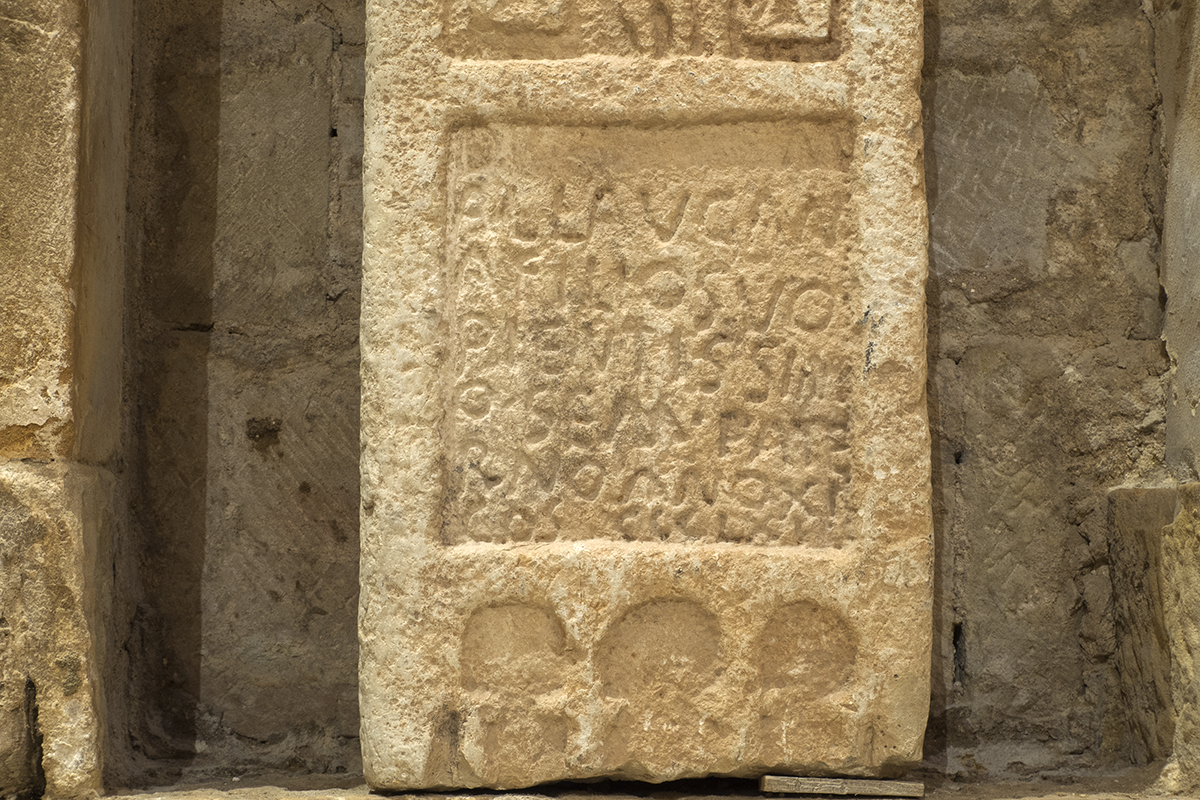
The central field is occupied by the inscription, arranged in seven lines of Latin capital letters. The reading is as follows:
D M
ALLAVGAN
AFILIOSVO
PIENTISSIM
O·SEM·PATE
RNOANOXI
COSCCCEXI
“To the gods Manes.
Allaugana dedicated this tombstone to her son, the most beloved Sempronius Paternus, who died at eleven years of age, in the consulate year 361.”
The text begins with the formula D M, an abbreviation of Dis Manibus, “to the gods Manes,” the protective deities of the deceased in Roman tradition. Next appears the name of the dedicant, Allaugana, who erects the stele for her son (a filio suo). The young man, Sempronius Paternus, is described as pientissimus, “most dutiful” or “most beloved,” and his age is specified: eleven years. The inscription leaves no doubt: a mother fixes in stone the name and memory of a son who died prematurely.
The final line introduces the date: COS CCCLXI. The abbreviation “COS” refers to consulatu, that is, “in the consulate.” This is not a mere ornamental formula, but part of a system of reckoning used in northern Hispania that employed its own era, distinct from the ordinary Roman consular dating. In these inscriptions, the year is not expressed through the names of the consuls in office, but by means of a numeral belonging to a continuous chronological system: the so-called Hispanic consular era.
The number CCCLXI, that is, 361, belongs to a chronological system whose starting point is traditionally placed in 38 BC. If that difference is subtracted, the corresponding date in our current reckoning is AD 323. This method of dating inscriptions appears concentrated in a specific territory within the Cantabrian and Palentine region, where, from the late third century onward, it replaced the classical consular dating that identified years by the names of the serving consuls. This is not a minor detail: it represents the adoption of a continuous system of temporal reference, specific to this geographical area, which remained in use for generations.
Over time, this computation extended beyond its original nucleus and became consolidated as the so-called Hispanic Era, eventually becoming the official dating system of the Visigothic Kingdom. From then on, it was widely used in the Christian territories of the Iberian Peninsula and continued in normal use until nearly the end of the Middle Ages.
At the bottom, three semicircular arches, separated by small impost blocks, close the composition. This stylized arcading motif is common in stelae from the northern Iberian Peninsula and visually organizes the base of the monument, balancing the ensemble formed by the upper wheel, the central figure, and the epigraphic field. The decoration, like the inscription, follows a recognizable scheme within the region’s funerary tradition.